COCOON
Lung cancer
A Phase 2 study to evaluate enhanced dermatologic care to reduce rash and
paronychia in EGFRm+ NSCLC treated first-line with
amivantamab (EGFR × MET bispecific Ab) plus lazertinib (3rd generation EGFR TKI)
Phase
Compound
Amivantamab (EGFR × MET bispecific Ab) + lazertinib (3rd generation EGFR TKI) + dermatologic management ± SOC
NCT identifier
NCT06120140
Enrollment
N=~300
For more information, including
contact details, please visit
the J&J Clinical Trial Finder
contact details, please visit
the J&J Clinical Trial Finder
Study overview & design
Key eligibility criteria*:
- Locally advanced or metastatic treatment-naive NSCLC
- EGFR exon19 del or exon 21 L858R mutation
- No history of ILD
- Participants with a history of brain metastases must have had all lesions treated as clinically indicated (no current indication for further definitive local therapy)
- Prior or concurrent second malignancy which natural history or treatment is unlikely to interfere with any study endpoints, safety, or the efficacy of the study treatment(s) are permitted
- Substudy: New-onset or persistent Grade ≥2 specific DAEIs of the scalp, face, or body
Study
design
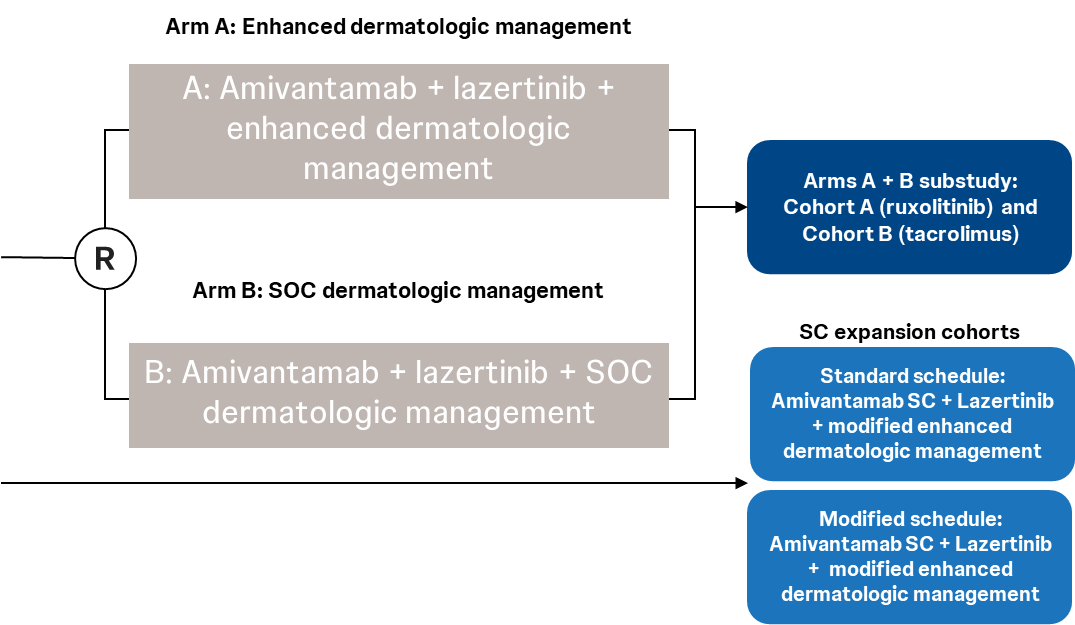
Primary outcome:
- Grade ≥2 DAEIs
Secondary outcomes†:
- DAEIs, paronychia and scalp rash by severity based on NCI-CTCAE v5.0
- Time to first occurrence of Grade ≥2 DAEIs
- Change from baseline in PROs
- AEs
- PFS
- ORR
- DOR
*Not a complete list of inclusion and exclusion criteria. †Not a complete list of secondary outcomes.
Ab, antibody; AE, adverse event; DAEI, dermatologic adverse event of interest; DOR, duration of response; EGFR, epidermal growth factor receptor; EGFRm+, epidermal growth factor receptor mutation; ILD, interstitial lung disease; MET, mesenchymal epithelial transition; NCI-CTCAE, National Cancer Institute Common Toxicity Criteria for Adverse Events; NSCLC, non-small cell lung cancer; ORR, overall response rate; PFS, progression-free survival; PRO, patient-reported outcome; SOC, standard of care; TKI, tyrosine kinase inhibitor.